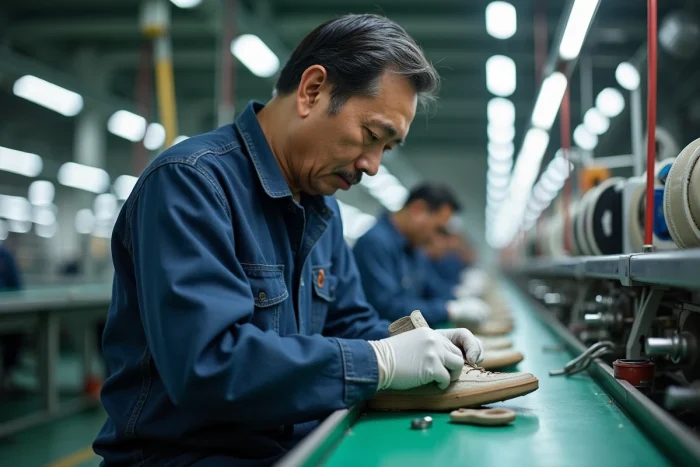
Skechers does not own any shoe manufacturing plants. The American brand, founded in 1992 in Manhattan Beach, California, operates under a so-called “asset-light” model: it designs its products in the United States and then entrusts all manufacturing to a network of contracted manufacturers, primarily located in Asia.
Skechers Manufacturing: A Model Without Owned Factories
This operation distinguishes Skechers from some competitors that maintain internal industrial capabilities. At Skechers, manufacturing relies entirely on subcontractors. The only infrastructures owned directly by the brand concern logistics, limited customization, and quality control at the end of the chain.
Specifically, design teams based in California develop prototypes and technical specifications. Asian suppliers then receive these specifications and ensure production. This model allows Skechers to remain flexible regarding volumes and to distribute risks among several industrial partners. To better understand where Skechers are made, one must look at the map of its suppliers rather than search for production sites stamped with the brand’s logo.
The capabilities that Skechers holds in-house focus on distribution. Its North American logistics center, certified LEED Gold, is located in California. In Europe, the brand operates from automated facilities in Belgium and the United Kingdom, supplemented by centers in China and India.
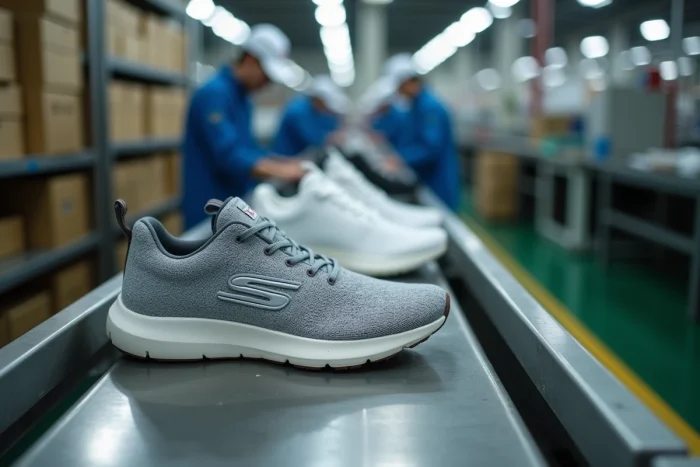
Countries of Manufacture for Skechers Shoes: China, Vietnam, Indonesia
China has long been the manufacturing base for Skechers. The brand began its commercial operations there in 2007, through a joint venture, and the first Chinese store opened in Shanghai in 2008. Contracted Chinese factories have ensured the majority of production for years.
This industrial geography is evolving. According to documents filed with the SEC (Form 10-K for the fiscal year 2024), Skechers is diversifying its production to Vietnam, Indonesia, and Cambodia. The share of Chinese manufacturing is decreasing in proportion, benefiting Southeast Asia and, to a lesser extent, Latin America.
Several factors explain this redistribution:
- Geopolitical tensions between the United States and China have increased customs and regulatory risks for American brands dependent on a single supplier country.
- Labor costs in Vietnam and Indonesia remain lower than those in China’s coastal provinces, making these countries attractive for mass production.
- The proximity of certain raw material basins (natural rubber in Southeast Asia, synthetic textiles) reduces supply lead times.
Skechers does not publish the exact distribution by country. The general trend, confirmed in its reports to investors, is towards a more geographically dispersed supply chain.
Quality Control and Skechers Supplier Code of Conduct
Delegating manufacturing does not mean relinquishing control. Skechers imposes a Code of Conduct on each supplier that covers working conditions, environmental standards, and the prohibition of forced labor.
This framework took on particular significance after the publication in 2020 of the report by the Australian Strategic Policy Institute (ASPI) titled “Uyghurs for Sale.” This report accused the Chinese government of transferring Uyghur workers to factories under conditions akin to forced labor and mentioned several major international brands.
Skechers publicly responded by stating that it had conducted internal investigations. In its official statement, the brand claims to apply its Supplier Code of Conduct and monitor compliance with these commitments. Since 2023, Skechers has ceased all direct engagement with suppliers based in the Xinjiang region, according to its sustainability report.
Traceability of Raw Materials
The brand now requires its suppliers to document the origin of cotton and synthetic fibers through audits conducted by independent third parties. This requirement responds to the Uyghur Forced Labor Prevention Act, the U.S. legislation that prohibits the importation of products related to forced labor in this region.

Global Logistics and Skechers Distribution Centers
Manufacturing is just one link in the chain. Once the shoes are produced in Asia, they pass through a logistics network that Skechers has structured across several continents.
- In North America, the main LEED Gold certified center in California manages flows to the domestic market and online commerce.
- In Europe, the automated facilities in Belgium serve the continent, supported by a regional center in the United Kingdom.
- Strategic centers in Central America, South America, and Asia complement the network to reduce delivery times.
- Some products are shipped directly from factories to distribution partners, bypassing a Skechers center.
Approximately 5,300 stores worldwide (owned by Skechers or third parties) constitute the last link before the consumer. The international market represents more than half of total revenue, which explains the investment in regional logistics platforms rather than a centralized model.
Skechers’ choice not to manufacture in-house is also reflected in its distribution strategy: the brand combines wholesale to major retailers, a network of boutiques, and direct online sales. This commercial architecture follows the same logic as manufacturing, namely minimizing physical assets while maintaining control over the finished product and customer experience.
The next step for Skechers seems to be deepening the geographical diversification of its suppliers. U.S. and European regulatory constraints on the traceability of raw materials will only strengthen, and the brand has already begun this shift with systematic third-party audits on the origin of the fibers used in its products.