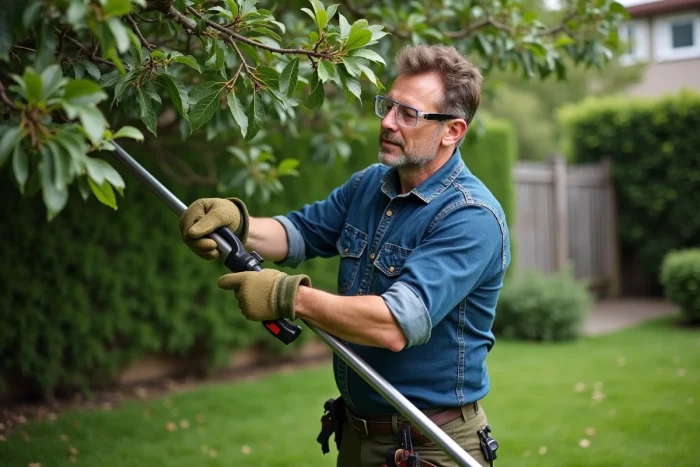
A pole saw is a lightweight chainsaw designed to cut branches of small to medium diameter with one hand or at the end of a pole. The term actually covers two very different families of tools in terms of handling, weight, and range of action. Choosing between the two, and then deciding on the motorization and guide length, directly affects the safety and efficiency of gardening work.
Chain and pole saw guide: understanding the cut before choosing the motor
Most guides first compare motorizations. However, the cut deserves to be examined first, as it determines the types of branches accessible and the fatigue experienced.
The cutting guide is the flat blade on which the chain runs. Its length sets the maximum diameter of branch that the tool can cut in a single pass. On a compact pole saw, the guide typically measures between 20 and 30 cm. Beyond that, one shifts to a traditional chainsaw, which is heavier and less maneuverable at height.
The chain itself varies in pitch and profile. A narrow chain pitch (often noted as 1/4 inch on the lightest models) reduces vibrations and requires less motor power. A wider pitch increases cutting speed but puts more strain on the arm. For regular pruning on branches a few centimeters in diameter, a narrow pitch combined with a short guide offers the best compromise between fatigue and efficiency.
Technical sheets also mention the chain speed. A high speed partially compensates for a short guide, as the chain moves through the wood faster. On recent battery-powered models equipped with brushless motors (without carbon brushes), the speed remains stable even when the battery drops below half its capacity, extending the useful working window.
Specialized resources like elagueuse-warrior.com detail these technical characteristics model by model, making comparison before purchase easier.
Compact pole saw or pole pruner: two tools, two uses
Confusion is common. A pruning chainsaw (also called a compact pole saw) is held with one hand. It rarely weighs more than three to four kilograms and is used to cut branches accessible from the ground or a ladder. Professional arborists use it harnessed in the tree.
The pole pruner attaches a motor block and cutting guide to the end of a tube, either telescopic or fixed, allowing access to branches located between three and five meters high without leaving the ground. The safety gain is real, but the total weight increases and cutting precision decreases with distance.
- Low-stem fruit trees, tall hedges, nearby dead wood: the compact pole saw is sufficient and offers better control.
- High branches on ornamental trees, plane trees, poplars: the pole pruner avoids the use of a lift or ladder leaning against the trunk.
- Mixed work on a large property: some manufacturers offer multifunction tools where the pruning head attaches to a common pole, reducing overall costs.
The choice therefore depends less on the desired power than on the usual cutting height. Buying a pole to prune at one and a half meters off the ground is like carrying unnecessary weight all day.
Motorization of pole saws: gas, battery, or corded
Three power sources coexist, each with practical constraints that product sheets do not always highlight.
Gas pole saw
A two-stroke engine, with a displacement usually between 25 and 35 cm³, and a mixed fuel tank. The autonomy is nearly unlimited as long as fuel is available, which is suitable for long jobs in remote areas.
The downside: the noise far exceeds the thresholds tolerated in dense residential areas. Some municipalities restrict the use of gas tools to specific time slots, or even encourage switching to electric. Engine maintenance (spark plug, air filter, carburetor) adds a recurring cost that battery-powered pruning eliminates.
Battery pole saw
The voltage varies by range: 18 V platforms for domestic use, more powerful platforms for semi-professional use. The priority point to check is the battery compatibility with other tools from the same manufacturer.
In recent years, inter-brand alliances like the Cordless Alliance System (CAS) led by Metabo and its partners allow the same battery to be used on pole saws, hedge trimmers, and blowers from different brands, reducing investment and the number of chargers.
Battery life remains the limiting factor. For regular maintenance, a medium-capacity battery offers about twenty minutes of effective cutting, often sufficient for a standard-sized garden.
Corded pole saw
Plugged into an outlet, it never runs out of battery and is cheaper to purchase. However, the extension cord limits the range of action and creates a risk of snagging in fallen branches. This type of tool is suitable for occasional use, very close to the house.
Safety and protective equipment for pruning
Professional organizations like FNEDT and Unep remind us that a pole saw, even lightweight, is still a chainsaw. Safety recommendations apply even in domestic gardens.
- Helmet with mesh visor and integrated ear protection, essential as soon as the chain is running.
- Certified cut-resistant gloves, different from regular gardening gloves.
- Cut-resistant pants (or chaps): the chain, in case of kickback, statistically hits the legs first.
- High-top shoes with front protection, for falling branches.
Wearing all of this protective gear significantly reduces the risk of serious injury, even on cuts that seem simple. The total cost of individual equipment remains modest compared to that of the tool itself.
A final point often overlooked: chain tension. A loose chain increases the risk of derailment and kickback. Checking the tension before each cutting session takes a few seconds and is the simplest preventive measure to adopt.