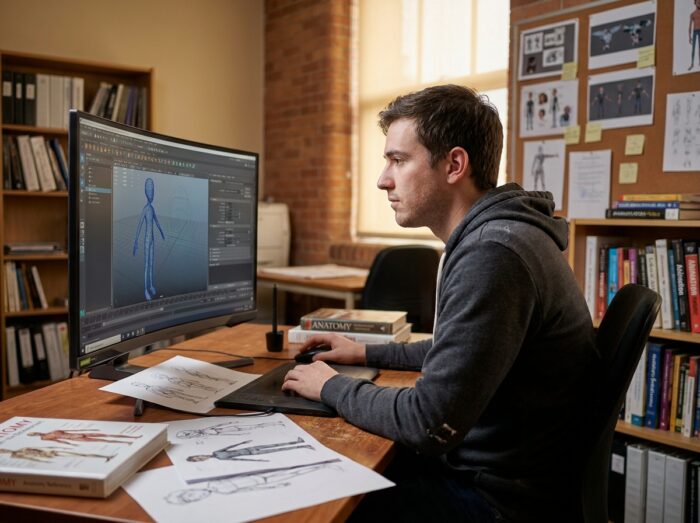
Even before touching a modeling software or learning to set animation keys, a future 3D animator must know how to draw a body in motion, understand how light sculpts a volume, and tell a story in a few images. This foundation is precisely what a year of animation prep builds. Far from being a mere formality, this step often conditions the rest of the journey, whether aiming for a selective public school or a bachelor’s degree in a private institution.
Animation prep and entrance exams: a prerequisite that goes unnamed
No major animation school officially requires having completed a prep course. The expected level for admission tests, however, presupposes a background that high school does not provide.
The majority of students admitted to the most selective animation cinema programs (Gobelins, ENSAD, Estienne) have completed at least one year of drawing and visual culture training. The examination juries assess the mastery of observational drawing, the ability to construct visual narration, and the artistic culture of the candidate. Without prep, the expected level for entrance exams is rarely achieved upon graduating from high school.
Why this gap? Because the high school curriculum, even with a specialization in visual arts, does not cover intensive life drawing, perspective applied to storyboarding, or the analysis of animated sequences. Attending an animation prep before specialized school helps bridge this gap and allows students to present a portfolio that holds up against candidates who may come from post-high school artistic training.
The prep also functions as a demanding sorting mechanism. A significant portion of enrolled students do not progress to the 3D animation curriculum at the end of the year. This filter encourages everyone to evaluate their motivation and work capacity early on, before committing to three to five years of costly studies.

What animation prep develops that an online tutorial cannot replace
Have you ever noticed the difference between a 3D character that “moves” and one that seems alive? This difference rarely comes from the software. It comes from the understanding of movement, weight, and rhythm, acquired through drawing.
Drawing as the foundation of 3D animation
In prep, life drawing holds a central place. The goal is not to train illustrators, but to train the eye to capture dynamic poses and understand anatomy in motion. A 3D animator who knows how to draw a pose anticipates the result on screen better.
This skill transfers directly into animation software. When a student sets a movement key in Maya or Blender, they are not just manipulating curves: they are translating a physical intention that they first understood on paper.
Visual narration and storyboarding
The prep also teaches image scripting. Breaking down a scene, framing a shot, pacing a sequence: these skills pertain to cinematic language, not 3D technique. An animator who masters storyboarding understands why a shot works, not just how to produce it.
In specialized schools, animation projects are often evaluated based on the quality of narration as much as on technique. A student who arrives without a foundation in visual storytelling loses several months catching up on this deficit.
Artistic culture and references
Preps include courses in art history, film analysis, and animation culture. This background allows for a critical perspective on one’s own work and situates their practice in a broader context, from traditional animation cinema to current video game productions.
General prep or specialized animation prep: what impact on the path
Not all artistic preps are equal for a future 3D animator. The choice between a general prep (applied arts, leveling) and a specialized animation prep changes the trajectory.
- The general prep covers a wide spectrum: graphic design, illustration, interior architecture. It suits students who are still undecided between several creative professions, but it dedicates little time to animation drawing, character design, or storyboarding.
- The specialized animation prep focuses the teaching on sequential narration, character drawing in motion, and an introduction to digital tools specific to animation cinema and game art. Each project is conceived from the perspective of animated images.
- The impact on the portfolio is direct: an animation school jury immediately spots a portfolio built around character research, storyboard panels, and dynamic sketches, compared to a portfolio oriented towards product design or static illustration.
In summary, if the destination is clear (2D animation, 3D animation, game art), a specialized prep directs every hour of work toward that goal. If doubt persists, the general prep leaves more doors open, at the cost of a less targeted portfolio for animation entrance exams.
First year in a 3D animation school: with or without prep, the difference is noticeable
Teachers at specialized schools notice it every new school year: students who went through a prep approach the first year with significantly greater autonomy. They know how to organize a creative project, accept criticism of their work, and manage a tight production schedule.
This advantage is not limited to drawing. The prep exposes students to teamwork on artistic projects, to the oral presentation of their intentions, and to managing creative doubt. These skills, invisible on a resume, make a difference when a year-end project must be delivered in a group under time constraints.
Conversely, a student who directly enters a bachelor’s program in animation after high school can succeed, provided they already have regular drawing practice and a solid visual culture. This profile remains minority. For most high school students attracted to animation careers, the prep structures the technical and narrative foundations that are lacking upon graduating from high school.