
When trying to access your professional email from a public Wi-Fi network or a shared workstation, the question is no longer just “how to connect,” but “how not to expose your credentials.” The Zimbra email used by the Pyrénées-Orientales department (CD66) operates via webmail accessible from any browser, making it convenient but also vulnerable if basic precautions are neglected.
Recent Zimbra Vulnerabilities: What Specifically Threatens Your Account
Competitors often merely recommend an HTTPS connection. The problem is that Zimbra remains an active target for attackers, regardless of the encryption of the connection.
The national cybersecurity agency of Azerbaijan has warned about malicious emails exploiting the CVE-2025-66376 vulnerability. On an unpatched version, opening a simple message could allow remote code execution, interception of correspondence, and account takeover. Published recommendations include monitoring unusual logins and unexpected password or configuration changes.
On the server side, CyStack lists vulnerabilities actively exploited on recent branches of Zimbra Collaboration. For an end user, this means one thing: ensure that the interface displays a valid certificate and an official URL before entering your credentials. If the URL or certificate seems unusual, do not log in and report the issue to the administrator.
You can also consult the Zimbra 66 email through a detailed guide that covers the step-by-step login procedure, which helps avoid landing on a phishing page while hastily searching for the URL.
Secure Connection to Zimbra CD66: Settings and Checks
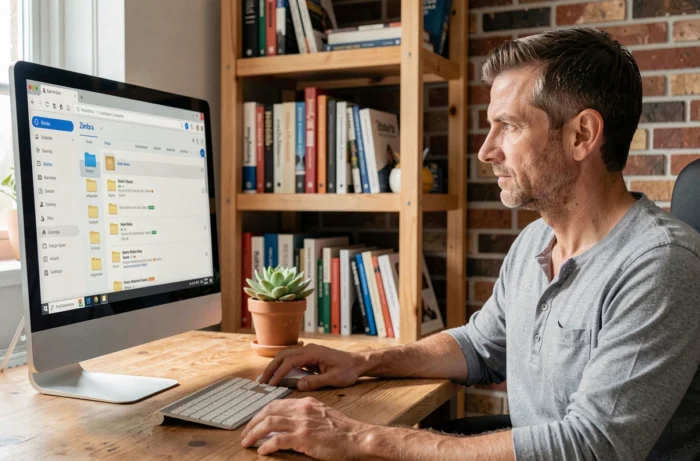
The connection is made through the web browser, without the need to install software. You enter your email address and password on the official webmail login page. The critical point is before even entering your credentials.
Checks Before Typing Your Password
- The URL in the address bar must exactly match the official CD66 domain, without extra characters or suspicious subdomains
- The browser’s padlock should indicate an encrypted connection (HTTPS protocol) with a valid SSL certificate
- If the browser displays a security warning, close the tab immediately and contact IT support
These checks take just a few seconds. They eliminate the majority of phishing attempts, which rely on visually identical pages but hosted on a different domain.
Settings for an External Email Client
If you prefer to use Thunderbird or another email client, configuration requires the IMAP server and SMTP server settings provided by the administration. SSL/TLS encryption must be enabled for both incoming and outgoing connections. Without this activation, credentials are transmitted in plain text over the network.
Feedback varies on the compatibility of certain mobile clients with the CD66 Zimbra server. In case of synchronization issues, the webmail remains the most reliable option.
Multifactor Authentication and CNIL Recommendations
On March 20, 2025, the CNIL adopted a recommendation regarding the processing of sensitive data and remote access to an information system. For institutional email, multifactor authentication (MFA) is no longer a luxury; it is an expected component.
If the CD66 administration has not deployed a complementary solution (authentication proxy, VPN with MFA), security relies entirely on the strength of the password.
In practical terms, this requires choosing a long, unique password for this account and never reusing it elsewhere. A local password manager (not a text file on the desktop) solves this problem without daily effort.
Managing Your Zimbra Emails Daily Without Wasting Time
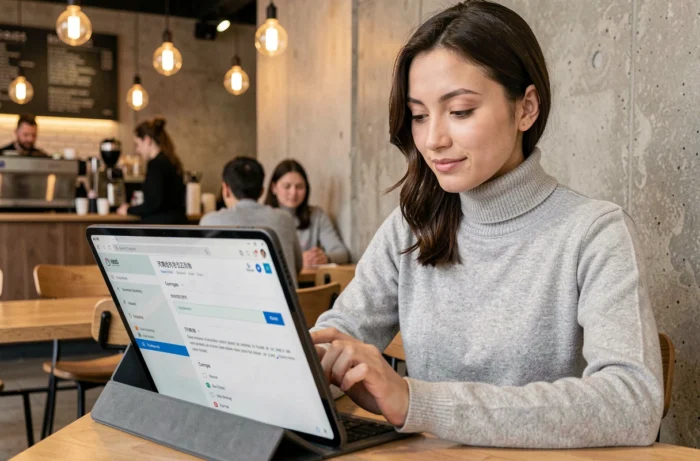
The Zimbra interface offers sorting and organization functions that are often underutilized. Two of them truly change the daily management of messages.
Automatic Filters on the Server Side
Zimbra allows you to create filter rules directly in the webmail settings. An email from a specific sender or containing a keyword in the subject can be automatically classified into a dedicated folder. These filters run on the server side, meaning they work even when you are not logged in.
To configure them, access the user settings, then the “Filters” section. You create a rule by defining the condition (sender, subject, recipient) and the action (move, mark as read, forward). Three or four well-thought-out rules are enough to eliminate daily noise.
Shared Folders and Delegation
In a professional context, the folder sharing function allows a colleague to access a specific mailbox without knowing the account password. You select the folder to share, define the access level (read-only or read/write), and the recipient finds this folder in their own webmail.
Folder sharing never transmits login credentials, which respects the principle of least privilege recommended for any information system.
Security Reflexes After Each Zimbra Session
Logging out is not always enough. On a shared workstation or a device that is not yours, you should also clear the browser cache and delete session cookies. An active Zimbra session cookie could allow the next person to access the account without a password.
- Click “Logout” in the Zimbra interface before closing the browser
- Delete cookies and cache via the browser settings, or use private browsing from the start
- Regularly monitor the login history in the account settings to spot any suspicious activity
These actions take less than a minute. They constitute the last line of defense when the server itself does not offer native MFA. A strong password combined with strict session hygiene covers most of the risks that a user of Zimbra 66 email is exposed to daily.