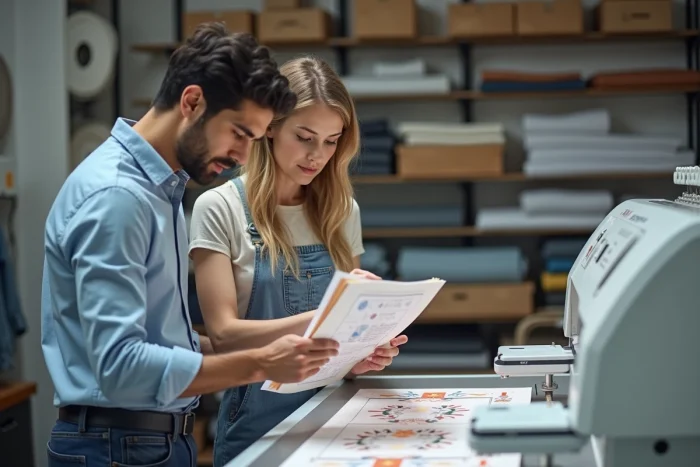
A change of supplier can lead to a sudden drop in the quality of customized textiles, even when the specifications remain unchanged. The differences between printing and embroidery go beyond the final appearance: each technique imposes its own production and cost constraints.
Many providers subcontract certain steps without clearly indicating it, which alters deadlines and control over the outcome. Therefore, selection relies as much on the guarantees provided as on the transparency of the methods used.
Understanding the stakes of choosing a customized textile provider
Textile customization now holds a prominent place in communication and visual identity strategies. Ordering customized t-shirts or sweatshirts is not just about choosing a design: it involves opting for a partner who knows how to orchestrate the entire chain, from purchasing the textile to delivery. A workshop in France does not just ensure textile printing or embroidery: it also promises consistent quality, an ethical approach, and controlled local production. This level of demand attracts both companies and associations, schools, clubs, or independent creators, all sensitive to both transparency and speed of execution.
Expectations are evolving: the demand for organic textiles, recycled materials, or Oeko-Tex or GOTS certified products is significantly increasing. Clients now require much more than just a garment: they are looking for a partner capable of guaranteeing certified materials, using eco-friendly inks, and engaging in a responsible approach. Local anchoring, embodied by Made in France, is becoming essential, especially for series intended to affirm a committed brand image.
The choice of textile supplier directly influences the perception of the quality of the final product, as well as delivery speed and the ability to meet specific needs. Between the custom clothing wholesaler offering a complete range, including t-shirts, polos, caps, and accessories, and the workshop capable of handling small and large series, everything relies on trust and reputation. Customer reviews and transparency about production become major criteria. To explore this aspect and learn more about IdentiTools, there are dedicated resources for selecting a textile printing and embroidery company in France.
Which techniques to prioritize for successful customization?
Textile customization relies on several methods, each suited to different uses and projects. Textile printing encompasses various solutions:
- Screen printing stands out for its vibrant colors and durability, ideal for large series of t-shirts, sweatshirts, or tote bags intended for events or communication.
- Digital technologies such as DTG (direct-to-garment printing) and DTF (direct film transfer) allow for precise reproduction of complex visuals, without limitations on color count or gradient effects.
- Digital textile printing caters to capsule collections, on-demand orders, and creations that require flexibility and diversity.
Embroidery adds a unique dimension to polos, caps, beanies, or bags. It provides durability, texture, and elegance, perfect for uniforms, corporate gifts, or garments with a refined image. This choice enhances the textile but requires prioritizing sufficiently legible designs and suitable materials, or risk losing clarity.
| Technique | Suitable materials | Advantages |
|---|---|---|
| Screen printing | t-shirt, sweatshirt, tote bag | Intense colors, controlled cost for large quantities |
| DTG / DTF | t-shirt, sweatshirt, light or dark textiles | Graphic freedom, speed, no minimum order |
| Embroidery | polo, cap, beanie, bag | Premium appearance, durability, brand enhancement |
The choice of technique depends on the textile, the complexity of the design, the image to convey, and the volume to produce. Workshops that master these different processes offer a customized adaptation to each project, from the most classic to the most creative.

Comparison of platforms and tips for selecting the right supplier
The print demand sector in France is dense and demanding: selecting a textile supplier is not just about filling a cart online. The details make the difference. Prioritizing a workshop in France ensures local production, real responsiveness, and better-controlled traceability. Oeko-Tex or GOTS certifications have become essential benchmarks for any company or creator concerned about the environment and health.
Analyzing customer reviews provides a concrete insight into follow-up, adherence to delivery deadlines, and management of special orders. A provider transparent about its methods, pricing, and materials, from organic textiles to responsible inks, inspires confidence. Personalized technical advice, access to samples, or genuine customer listening are major assets.
The variety of products offered, including t-shirts, sweatshirts, polos, caps, accessories, must be accompanied by responsive customer service and an intuitive interface. For e-commerce merchants or distributors, compatibility with major CMS and ease of order integration should be closely examined.
Here are the criteria to consider for making the right choice:
- Local production: a guarantee of quality and adherence to deadlines
- Labels and certifications: Oeko-Tex, GOTS to ensure a responsible approach
- Transparency regarding pricing, the origin of textiles, and the techniques employed
- Responsiveness of customer service and ability to handle custom requests
The ideal textile supplier is one that combines reliability, choice, and commitment, while remaining in tune with the concrete needs of professionals. In the end, customized textiles are no longer just a medium: they become the tangible showcase of a requirement and a vision.