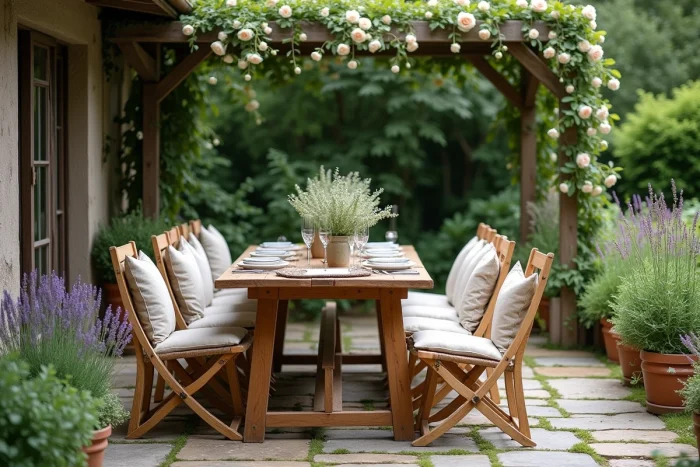
A natural outdoor layout is not just about laying grass and a few perennials. The choice of materials, management of acoustic constraints, and composition of plant layers determine the project’s durability as much as its appearance. Here, we address the technical points that general public guides often overlook.
Urban garden design: managing road noise and pollution
The majority of tutorials showcase gardens photographed in the countryside. In a suburban context, road noise and fine particles radically change design choices.
To reduce noise, a dense evergreen hedge with a minimum depth of two meters reduces sound perception much more effectively than a rigid fence. Plants with thick foliage (cherry laurel, privet, yew) absorb and diffract sound waves, whereas a smooth wall reflects them. Combining the hedge with a berm planted with tall grasses allows for even greater noise reduction without sacrificing natural aesthetics.
Regarding pollution, certain species are better at capturing fine particles than others. Birch, hornbeam, and ivy are among the most documented plant filters. We recommend placing them in the front line, facing the pollution source, and reserving convivial spaces (terrace, dining area) set back, protected by this living barrier.
Decree No. 2025-847 of November 12, 2025, now regulates the use of certain materials in outdoor layouts, with strengthened requirements for permeable surfaces. An outdoor layout project in an urban area must incorporate this constraint from the outset.
Natural materials for terraces and pathways: balancing wood, stone, and composite
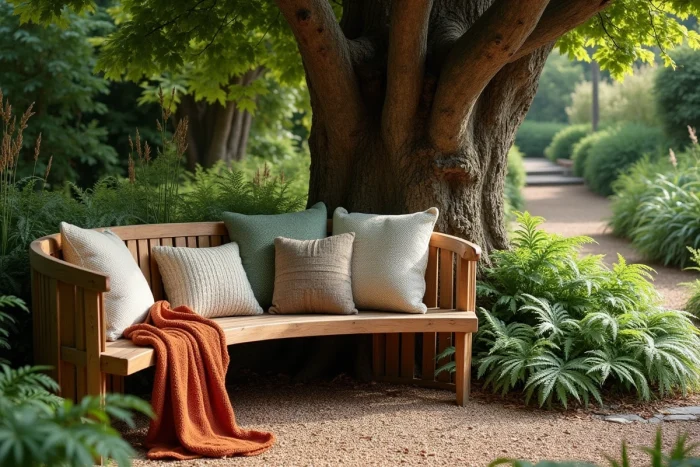
The choice of terrace material determines maintenance over ten to fifteen years. Uncertified exotic wood ages poorly and poses an environmental problem. Autoclaved softwood turns gray in two seasons without treatment. Thermally modified wood (ash, poplar) offers the best durability-natural appearance compromise for a convivial garden.
For pathways, natural local stone stepping stones avoid long-distance transport and integrate into a living soil (creeping thyme, baby tears between the slabs). Professionals sharing their projects on the L’Herbe sous le Pied website demonstrate how to combine mineral and plant elements without artificializing the soil.
A often overlooked point: permeability. A mortar-jointed paving is as impermeable as a concrete slab. Favoring sand-gravel joints or grassed joints maintains natural infiltration and complies with regulatory obligations regarding stormwater management on the property.
- Thermally modified wood: class 4, no chemical treatment, slow and even graying
- Local limestone: low transport footprint, naturally slip-resistant surface, gradual patina
- Stabilized crushed gravel: permeable, suitable for secondary passage areas, cost-effective
- Next-generation composite: partially recyclable, but less natural feel and high surface heat in summer
Plant layers and conviviality: structuring outdoor space without partitioning
A natural garden operates in three layers: tree, shrub, and herbaceous. This layering creates visual depth and microclimates favorable to biodiversity while delineating living areas without resorting to artificial separations.
The tree layer (one or two small-growing trees like field maple or ornamental pear) provides shade for the dining area. The shrub layer (dogwoods, viburnums, deciduous euonymus) filters views without creating an opaque wall. The herbaceous layer (grasses, ground-cover perennials, aromatics) dresses the base of the beds and reduces weeding.
France Nature Environnement recommends in its 2025-2026 guide to favor local and nectar-rich species to maximize the welcome of beneficial wildlife. A bed of sage, oregano, and lavender fulfills this role while creating an olfactory ambiance around the terrace.
Outdoor lighting: enhancing conviviality without disturbing wildlife
Lighting transforms a garden into a nighttime living space, but cold white light disrupts the cycles of pollinating insects. We recommend sources with a color temperature below 2,700 K, directed downward, with a timer or motion detector.
Low-voltage solar string lights are sufficient to mark a pathway. For the dining area, a pendant light under a pergola, powered by very low voltage, provides adequate comfort without lighting up the sky. The goal: to see without dazzling, to welcome without polluting.
Integrated vegetable garden and sharing zones: a layout that creates connection
The INRAE report on gardens and social ties in suburban areas (September 2025) highlights that the presence of a vegetable garden increases the frequency of exchanges between neighbors. Integrating a few planting squares into a decorative garden is not a gimmick: it is a measurable lever for conviviality.
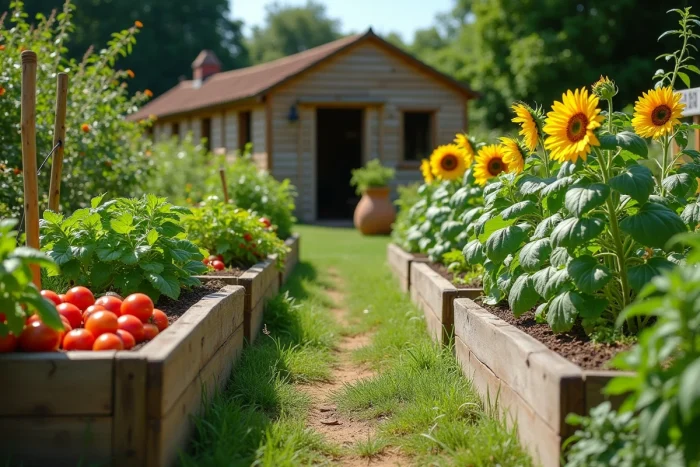
In practice, raised beds made of thermally modified wood or corten steel, placed near the terrace, allow for growing herbs, tomatoes, and salads without altering the garden’s layout. UNEP notes in its 2026 landscaping trends that the demand for vegetable gardens integrated into garden design is growing significantly.
- Place vegetable beds close to the kitchen for quick daily access
- Combine edible flowers (nasturtiums, marigolds) to attract pollinators and beautify the beds
- Provide a water point (outdoor tap or rainwater collector) within ten meters of the growing areas
A natural and convivial outdoor layout cannot be decreed from a catalog. It is built by intersecting the site’s constraints (noise, pollution, soil, exposure) with the actual uses of the inhabitants. The choices of permeable materials, filtering plants, and reasoned lighting form a solid technical foundation on which conviviality can be established sustainably.