
The string trimmer and brush cutter share a principle of rotary cutting, but their cutting components, motorization, and range of use separate them radically. Confusing the two means choosing an undersized or oversized tool for the area to be treated.
Cutting components and kinematics: what really separates the two machines
The cutting head is the determining technical criterion. A string trimmer (edger) works exclusively with a thin nylon line, usually round or serrated. This line spins at high speed but offers cutting capacity limited to soft grasses and low weeds.
The brush cutter accepts several cutting configurations depending on the density of vegetation. It ranges from a reinforced nylon line (with a larger diameter than that of the string trimmer) to a two or three-tooth steel blade, or even a brush blade for brambles and young woody plants. This mechanical versatility does not exist on an edger.
We recommend understanding the difference between brush cutter and string trimmer before any purchase, as the type of cutting component affects the safety of use and the durability of the machine.
The engine torque is sized accordingly. On a brush cutter, the drive shaft (rigid, often splined) withstands the stresses of a metal blade striking semi-woody stems. On a string trimmer, the shaft is often flexible or cable-based, sufficient to drive a nylon line but unsuitable for a blade.
Gas, battery, or corded motorization: impact on the choice between string trimmer and brush cutter
Regulation (EU) 2016/1628 (Stage V) on emissions from non-road engines has accelerated the transition. Manufacturers are gradually reducing the supply of small polluting two-stroke engines in favor of four-stroke models or battery versions for domestic use.
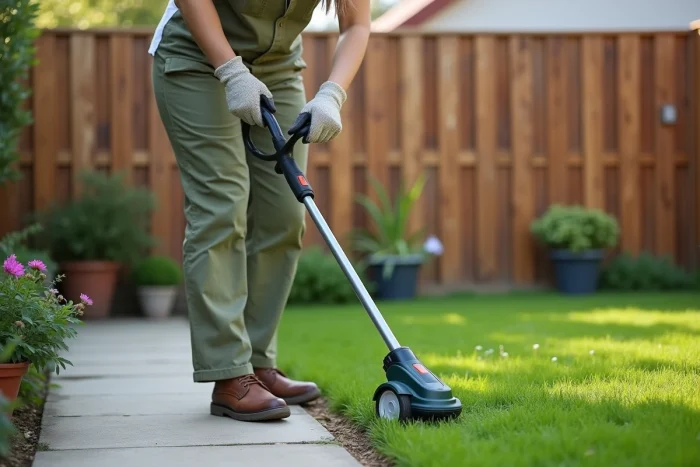
A corded electric string trimmer is perfectly suited for small gardens, where proximity to an outlet is sufficient. For larger areas, battery-powered models (lithium-ion) now offer enough autonomy for a complete finishing session.
The gas brush cutter remains relevant in overgrown plots, slopes far from any power supply, and regulatory brush clearing sites (legal obligations for clearing in fire risk zones). Its engine, often between 25 and 50 cm³, provides constant torque even in dense vegetation.
Noise nuisances and urban constraints
In recent years, many municipalities have restricted the hours of use for gas-powered tools. The “low noise” certified battery ranges from Stihl, Husqvarna, or EGO meet this constraint. In residential areas, a battery-powered string trimmer is often the only tool usable without time restrictions.
We observe that this acoustic criterion increasingly weighs in the purchasing decision, sometimes more than raw power.
Brush cutter or string trimmer: selection criteria based on terrain and vegetation
The right tool depends on three concrete parameters that we detail below.
- Nature of the vegetation: maintained grass, weeds, brambles, woody shoots. The nylon line of the string trimmer does not cut beyond soft grasses. As soon as the stem resists the line, a blade is needed.
- Surface and accessibility: a string trimmer excels on edges, wall bases, and around flower beds. The brush cutter is essential on steep slopes, undergrowth, and areas that have not been maintained for several months.
- Maintenance frequency: a garden mowed every week only requires a string trimmer for finishing touches. A plot maintained two or three times a year demands the power of a brush cutter equipped with a blade.
The trap of using a string trimmer as a brush cutter
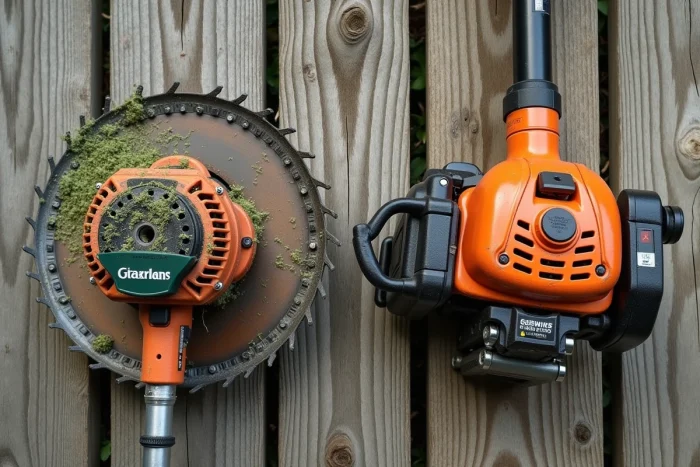
Forcing an edger into thick vegetation causes the motor to overheat, abnormal wear of the line, and a poor result. The line breaks in loops, the head empties in minutes, and the user ends up spending more time reloading the line than cutting.
Conversely, using a gas brush cutter to trim a grass edge along a path is disproportionate: excessive weight, debris projection, risk of damaging surfaces.
Maintenance and consumables: nylon line, blades, and real cost of use
The nylon line is a fast-rotating consumable. Its diameter, shape (round, star-shaped, square), and quality directly influence cutting efficiency and duration. A low-quality line breaks faster and cuts less cleanly.
Brush cutter blades, on the other hand, can be sharpened. A well-maintained steel blade lasts several seasons before replacement, which reduces the cost per hour of use in the long term.
- String trimmer: frequent line replacement, cleaning of the head, checking the protective cover.
- Gas brush cutter: engine oil change, air filter, spark plug, sharpening or replacement of blades, greasing of the angle drive.
- Battery brush cutter: reduced mechanical maintenance, but monitoring of battery condition (charge cycles, storage away from frost).
The overall budget is not limited to the purchase price. Over several years, a gas brush cutter costs more in engine maintenance, but it handles areas and vegetation that no string trimmer can manage.
The choice between these two tools relies on an honest assessment of the terrain, vegetation, and frequency of intervention. A string trimmer complements a mower for finishing touches. A brush cutter replaces the mower where it cannot go. Many gardeners end up owning both, each assigned to its specific task.